Our guides focus on home fit, everyday use, upkeep, and value. Retailer links in this story are ordinary links; no commission is earned from them. Read our affiliate disclosure.
In this story
Measure the space you actually want to filter
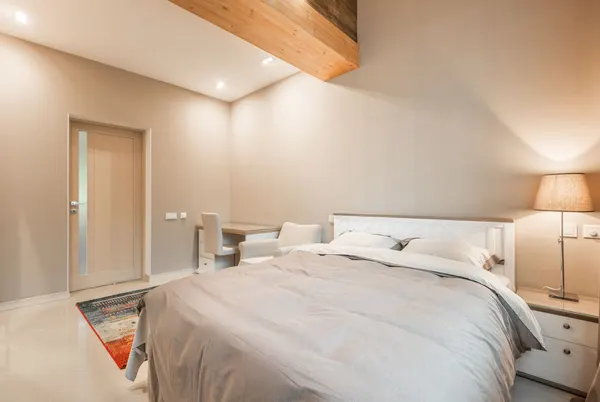
A purifier advertised for a large apartment may only circulate that much air once an hour. Start with the room where it will operate, rather than the biggest square-foot number on a box. Measure length and width, then note ceiling height and whether the door normally stays open. A bedroom with a closed door is a different sizing problem from a living room that opens onto a kitchen and stairwell.
Divide an L-shaped room into rectangles and add their areas. For an open-plan space, include connected areas without meaningful separation. Do not assume that a machine at the end of a hallway distributes clean air equally to every bedroom. If nighttime use is the priority, a dedicated bedroom unit may be more practical than one powerful machine parked elsewhere.
Translate coverage into air changes
CADR, or clean air delivery rate, describes delivered particle-cleaning capacity, commonly in cubic feet per minute in US listings. Air changes per hour, abbreviated ACH, describe how that flow compares with room volume. The useful calculation is CADR × 60 ÷ room volume. This is an equivalent clean-air calculation, not a claim that every corner receives perfectly mixed air.
For example, a 15-by-20-foot room with an 8-foot ceiling contains 2,400 cubic feet. A 200-cfm CADR produces a calculated 5 ACH. Raise the ceiling to 10 feet and the same machine produces 4 ACH. To reach a comparison target of 4.8 ACH in that taller room requires approximately 240 cfm. These are arithmetic examples, not measured performance or a universal guarantee.
| Example space | Volume | CADR for calculated 4.8 ACH |
|---|---|---|
| 150 ft², 8-ft ceiling | 1,200 ft³ | 96 cfm |
| 300 ft², 8-ft ceiling | 2,400 ft³ | 192 cfm |
| 300 ft², 10-ft ceiling | 3,000 ft³ | 240 cfm |
| 500 ft², 8-ft ceiling | 4,000 ft³ | 320 cfm |
Compare models on the same basis
The US specification tables checked for this guide list the Levoit Vital 200S-P at 388 square feet, Blueair Blue Pure 311i Max at 439 square feet, and Coway Airmega AP-1512HH at 361 square feet, each at 4.8 ACH. That makes their coverage meaningfully comparable. The Blueair page also retains an older 465-square-foot title; its current technical table and update note are the basis used here.
Those figures are a starting point. Maximum published airflow does not describe every speed setting. If you want a quieter setting overnight, allow room in the shortlist for a larger machine, but ask for speed-specific CADR data before assuming how much capacity remains. A larger housing or a low minimum decibel claim does not establish that answer.
Use a placement plan before checkout
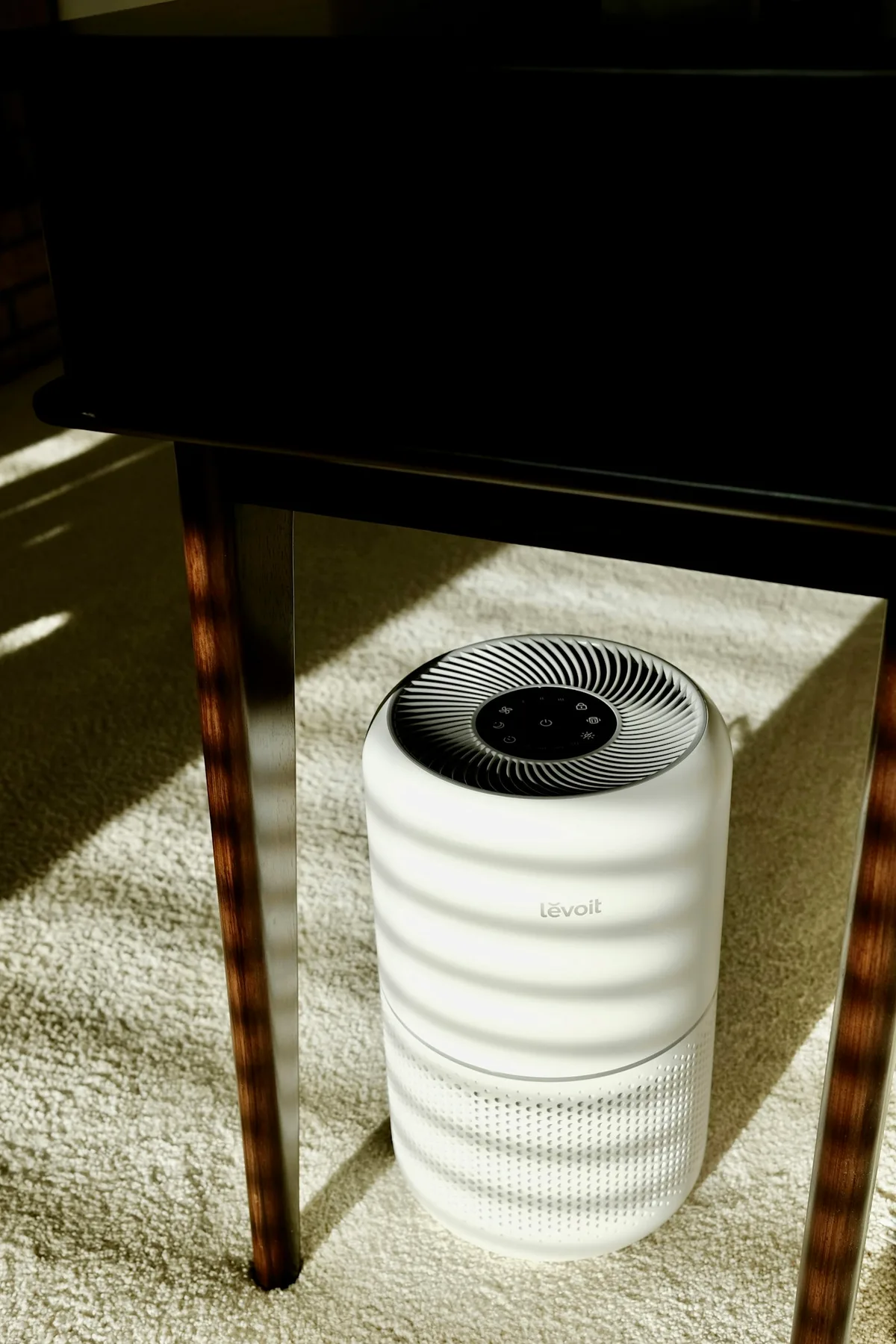
Mark a location with the clearance required by the exact manual, an accessible outlet, and an unobstructed intake and outlet. A purifier wedged behind a sofa can be a poor purchase even when its specification looks sufficient. Include the space needed to open the filter compartment without moving a heavy cabinet.
For adjoining rooms, consider two units positioned where people spend time. Adding their CADRs gives a useful planning estimate only when they serve the same connected air volume; it does not turn closed doors into open airflow paths. Also budget for two replacement filters and the sound of both devices.
Keep the particle goal separate from other air problems
EPA treats filtration as a supplement to source control and ventilation. Particle CADR does not rate gas removal, so use a vented range hood for cooking emissions and address the source of persistent odors. More filter airflow cannot repair damp materials, remove a leak, or make a room's carbon dioxide disappear.
Our buying approach is to choose a realistic room target first, shortlist machines with comparable published capacity, and then choose among them for usable speed, placement, and upkeep. This guide is based on documentation and calculation; it does not include hands-on clearance tests or measured room-cleaning times.
The considered choice
Compare CADR and coverage at the same ACH, account for ceiling height, and size around the speed and room you will actually use.
Put the guide to work
Take your measurements and must-have list with you. These retailers are useful places to compare options; check the exact listing, current price, delivery terms, and return policy before buying.
Levoit
Air purifiers and humidifiers for room-by-room home comfort.
Explore Levoit ↗Opens the retailer’s websiteBlueair
Air purification products with room-size and filter information.
Explore Blueair ↗Opens the retailer’s websiteCoway
Air purifiers with published CADR, room, and filter specifications.
Explore Coway ↗Opens the retailer’s websiteA few common questions
Does 1 ACH mean the purifier cleans every particle in an hour?
No. It is an equivalent airflow figure relative to room volume. Mixing, incoming particles, placement, and continuing sources affect what happens in a real room.
Can I use the home's total square footage?
Only if the intended space is genuinely connected and the device is sized for that air volume. For separated rooms, plan room by room.
Is a HEPA label enough to choose a size?
No. Filter efficiency and the amount of filtered air delivered are different. Check CADR and the coverage calculation as well.
Sources & further reading
- EPA: Guide to Air Cleaners in the Home — checked 2026-10-03
- Levoit: Vital 200S-P published specifications — checked 2026-10-03
- Blueair: Blue Pure 311i Max technical specifications — checked 2026-10-03
- Coway: Airmega Mighty AP-1512HH specifications — checked 2026-10-03
This is a research-based buying guide. We do not claim hands-on testing of the products linked here. Product details and availability can change. How we work · Suggest a correction